 The Isle of Mull is the second largest island of the Inner Hebrides and the largest island of the Southern Hebrides. Mull has an incredible coastline of around 300 miles and an area of 338 square miles. The highest mountain on Mull is Ben More, with 966 metres the highest mountain in the area, and on a clear day visible from almost every island of the Southern Hebrides. Mull is a mountainous island and Ben More is the only Munro in the Southern Hebrides. Perhaps because of these mountains Mull has the highest rainfall numbers of all of the Hebrides. Main industries on Mull are tourism and fish farming. The island is surrounded by the Sound of Mull in the north, the Firth of Lorn in the south and east and the Atlantic Ocean in the west.
Although larger than Islay, the population of Mull is less, around 3,000 people, and approximately 1.000 of them live in the picturesque harbour town of Tobermory with its colourful buildings. Tobermory is also the administrative capital of Mull, its name meaning Mary’s well. The town was founded as a fishing port in 1788 on a layout designed by the British Fisheries Society. Tobermory is well served with facilities and the town includes a museum, accommodation, banks and tourist information. Many buildings in Tobermory, mostly shops and restaurants, are painted in different bright colours, making it a popular location for television programmes, and gives the town a unique character. Important buildings in the town include Tobermory Clock Tower, a museum, the Tobermory Scotch whisky distillery and an arts centre.
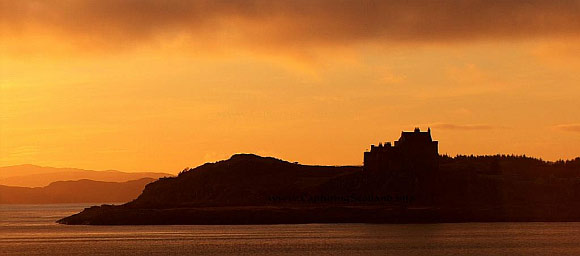
Duart Castle at Sunrise
Like many other islands in the Southern Hebrides people started living here not long after the last ice age which was around 8000 BC. Mull itself has been inhabited since around 6000 BC and the inhabitants of those days were responsible for the standing stones, brochs and stone circles such as the Lochbuie stone circle, not far from Craignure which is still well preserved. After the Norwegian controlled the island from the 8th century, Mull also became a part of the Lordship of the Isles in 1266, which had its main seat of power on Finlaggan Islay. Duart Castle dates back to the 13th century and was the seat of Clan MacLean. In 1350 Lachlan Lubanach Maclean of Duart, the 5th Clan Chief, married Mary, daughter of John of Islay, Lord of the Isles and she was given Duart as her dowry. After the collapse of the Lordship in 1493 the island was taken over by the clan MacLean, and later in 1681 by the clan Campbell. The Highland clearances of the 18th and 19th centuries left its mark on Mull as well and came after voluntary emigration when there was overpopulation, 10,600 inhabitants, in the early 1800s. The population fell to a low of 2154 in 1961 and is has now reached a stable number.

Overlooking Loch Tuath towards Treshnish Isles
Standing on a clifftop guarding the Sound of Mull, Duart Castle enjoys one of the most spectacular and unique positions on the West Coast of Scotland. Duart Castle has been the base of the Clan Maclean’s for over 400 years. In 1991 Sir Lachlan Maclean, the present Clan Chief engaged Professor Sir James Dunbar Naismith to repair the castle. The main repairs were completed in 1995, but work on the castle still continues. Torosay is a spectacular 150 year old Scottish baronial style castle and surrounded by magnificent gardens. The castle is located just a mile from the ferry pier at Craignure and was also connected by its very own narrow gauge steam railway but it closed in 2010.

View from the Sound of Ulva to Ross of Mull and Iona
Mull is home to over 250 different bird species including the White-tailed Eagle, which was reintroduced in the nearby Island of Rùm and migrated to Mull, where they now have a stronghold. Loch Frisa in the north is a viewing site for Sea eagles. In the central part of Mull is Glen More where birds like the Hen Harrier, Golden Eagle and Buzzard can be spotted along with mammals such as Red Deer. Due to it’s huge coast line Mull is also a fantastic island to spot sea birds and waders. Minke whales, porpoises and dolphins are among the sea life that can be seen on boat tours from Mull.

Oystercatchers at Loch na Keal
Dotted around the coast of Mull are numerous other (famous) islands such as Iona, Ulva and Gometra, the Treshnish Isles, Staffa, Eorsa and Inch Kenneth. The presence of these remote and beautiful islands adds to the fascination of Mull.
Mull has no airport as such, merely a landing strip for private planes. The island is well served with ferries and the main links to Mull from the mainland include Oban to Craignure (approx. 45 minutes), Kilchoan to Tobermory and Lochaline to Fishnish (approx. 15 minutes, suspended in rough weather). Although advanced bookings are not required for the Fishnish ferry it is a further drive north over single-track roads. A bus service is available on the island. The majority of the roads are single track and the only exceptions are the stretch between Craignure and Salen and a wee stretch south of Tobermory.
 Isle of Mull Community & Local Websites. Tourist Information:
Mull Pictures – A Gallery with Mull Pictures
www.isle-of-mull.net – Explore Mull Visitor Information
www.holidaymull.co.uk – Holiday Mull visitor information and accommodation
www.mull.zynet.co.uk – Mull and Iona chamber of commerce
www.wildaboutmull.co.uk – Wild about Mull – Wildlife tours
www.visitscottishheartlands.com – Tourist Information for Argyll
Travel Report – Touring the North of Mull Febr 2009
www.tobermory.co.uk – Tobermory Local info.